
From 18 November 2025: UK Identity Verification Rules – What Non-UK Real Estate Investors Must Know

By Staurus Properties | October 2025 Introduction: A New Era for Company Transparency The UK property market is tightening its regulatory framework.Starting 18 November 2025, Companies House will enforce a new rule requiring identity verification (IDV) for all company directors, beneficial owners (PSCs), and authorised filers. For non-UK investors — especially those from Nigeria and across Africa — this update affects how you set up and manage your UK property companies. What Is Changing on 18 November 2025 Under the Economic Crime and Corporate Transparency Act 2023, every UK company must have verifiable, traceable individuals behind it. The new identity verification regime will: Require directors and PSCs to verify their identity before incorporation or appointment. Prevent unverified individuals from registering or filing on behalf of a company. Extend to overseas entities with a UK establishment (e.g., property-owning companies). Grant a 12-month transition window for existing companies to complete verification. Verification will be done via GOV.UK One Login or an Authorised Corporate Service Provider (ACSP), such as a UK solicitor or company formation agent. Why the UK Introduced Identity Verification The goal is simple — to protect the integrity of the UK corporate register and reduce economic crime.Over the past decade, UK property structures have occasionally been exploited by anonymous owners. These reforms will: Combat money laundering and fraud. Increase trust and credibility in the UK business environment. Align with global AML (Anti-Money Laundering) and beneficial ownership standards. Create a safer landscape for legitimate investors and institutions. How the Change Impacts Non-UK Property Investors Verification Is Now a Legal Prerequisite If you plan to buy UK property through a limited company, you must complete ID verification before incorporation.Applications without verified directors will not be processed. All Directors and PSCs Must Verify Even if you appoint a UK-based director, your own identity — as the beneficial owner — must also be verified.Unverified individuals may be blocked from filings or flagged on the public register. Extra Steps for Overseas Nationals Foreign investors will likely need to use Authorised Corporate Service Providers to handle verification on their behalf.This is particularly useful if your passport or ID comes from a jurisdiction outside standard UK data-sharing networks. Expect Slight Delays During Incorporation Whereas company setups once took 24–48 hours, processing time may now extend depending on document readiness and verification speed.Preparation is key to avoiding disruption to your deal timeline. Stronger Transparency = Stronger Credibility Verified ownership enhances your reputation with lenders, banks, and partners — showing that your investment structure meets the UK’s highest compliance standards. What Happens If You Don’t Verify Failure to verify identity can lead to: Refused incorporation or blocked director appointments. Inability to file annual accounts or confirmation statements. Public notation as “identity not verified” on the Companies House register. Fines or enforcement for repeated non-compliance. For property investors, this means potential transaction delays, financing issues, and reputational risk. Practical Steps to Stay Ahead ✅ 1. Audit Your Corporate Structure List all current UK companies and identify unverified directors and PSCs. Begin preparing documents now. ✅ 2. Complete Early Verification You can voluntarily verify before 18 November 2025 through GOV.UK One Login. Doing it early avoids complications later. ✅ 3. Partner with an ACSP If you’re based outside the UK, use an authorised UK service provider to complete IDV on your behalf — quickly and securely. ✅ 4. Include Verification in Deal Planning Allow additional time for ID verification when structuring new SPVs (Special Purpose Vehicles) or property purchases. ✅ 5. Stay Updated on Future Phases Companies House will soon extend IDV to partnerships and corporate directors — keep your compliance team informed. Example Scenario: Nigerian Investor Case A Lagos-based investor forms a UK company to acquire a £250,000 buy-to-let property in Manchester.Under the new system, the company cannot be registered until both the director and beneficial owner have completed identity verification. Without preparation, this could delay completion or mortgage drawdown — but with early IDV via an ACSP, the process remains smooth and compliant. How Staurus Properties Can Help At Staurus Properties, we support overseas investors through every stage of their UK property journey. Our team can help you: Set up compliant UK investment companies. Coordinate identity verification through authorised partners. Source high-yield properties across Manchester, Liverpool, and Northern England. Maintain full compliance with UK company law and HMRC requirements. Final Thoughts The new Companies House identity verification rules mark a significant step towards transparency and accountability in UK business.For serious investors, they are not a barrier — they are an opportunity to demonstrate integrity and operate confidently within the UK system. Early preparation is the smartest way forward.Start verifying now, stay compliant, and keep your UK property investments future-ready. Proverb: “The road may be long, but it is the clear path that leads safely home.” — Nigerian Proverb Disclaimer Staurus Properties provides guidance and educational information for property investors. We do not offer financial or legal advice. Always seek independent professional advice before making any investment decisions.
🌍 Spring Statement 2025: What It Means for Non-UK Property Investors
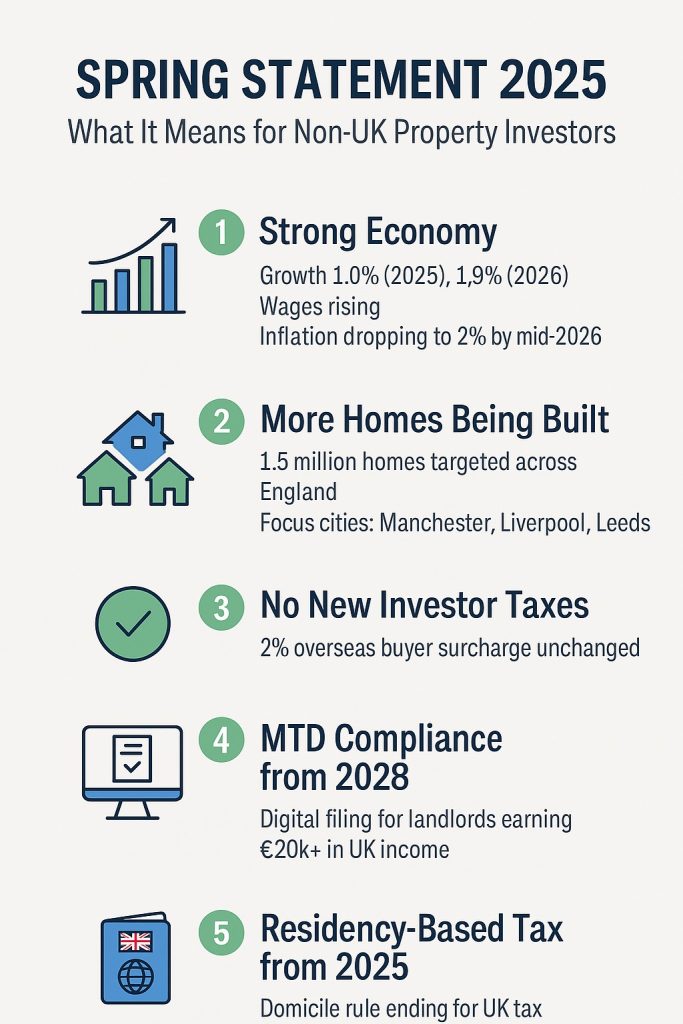
Author James Adebayo, Senior Real Estate Consultant (UK & Nigeria) The UK’s Spring Statement 2025 has just been released, and while much of it focuses on domestic reforms and economic stability, non-UK property investors will want to pay close attention to some key developments. From planning reforms and housebuilding pledges to tax clarity and digital compliance, there’s plenty in the statement that could influence your next investment move. Here’s what you need to know—broken down and simplified. 📈 A Stronger Economic Outlook The UK economy is forecast to grow 1.0% in 2025 and speed up to 1.9% in 2026, with inflation projected to fall near the 2% target by mid-2026. This spells stability—good news for investors who value predictable returns and long-term capital growth. Real wages and household incomes are rising, meaning more people can afford to rent quality housing—strengthening the rental market fundamentals. 🏗️ Major Housebuilding Reforms One of the most investor-friendly announcements is the government’s ambitious housing supply drive: This increased supply will help open up new pockets of opportunity—particularly in high-growth cities like Manchester, Liverpool, Birmingham, and Leeds. For international buyers, this means more stock, more choice, and better entry points into emerging hotspots. 🛠️ £625 Million for Construction Skills To ensure housing targets are met, the government is funding training for 60,000 new construction workers. This should help alleviate labour shortages that have been driving up build costs, and may help smooth timelines for property developments and refurb projects. 🧾 No New SDLT or CGT Changes (Good News!) Crucially, the Chancellor did not introduce any new Stamp Duty Land Tax (SDLT) or Capital Gains Tax (CGT) changes for overseas investors. ➡️ The 2% overseas buyer surcharge introduced in 2021 remains unchanged. This provides continued clarity for investors, especially those using corporate or offshore structures. 💻 Tax Compliance: Digital & Offshore Focus The government is placing a spotlight on transparency and compliance: 💡 Tip for investors: Now is the time to review your tax structure, ensure full compliance, and work with UK-based professionals who understand these updates. 💼 Domicile Status Scrapped – Welcome to a Residency-Based Regime From 6 April 2025, the UK will shift to a residency-based tax regime, removing the outdated “non-dom” status. While full details are still being finalised, this change aims to attract international talent and investment, offering a fairer and clearer framework for foreign investors and residents alike. 🔍 Summary: What It Means for You Area Impact Investor Action Housing Supply More properties on the market Explore emerging cities with high ROI potential SDLT/CGT No tax hikes Continue with planned purchases confidently Tax Compliance Digital and offshore scrutiny increasing Review your structure and prepare for MTD Economic Forecast Growth, falling inflation, higher incomes Expect steady rental demand and capital appreciation Residency Tax Reform More transparency, modern framework Stay informed; structure your investments wisely